A fire pit is the cheapest way to make a backyard somewhere people actually stay. But a ring of blocks in the middle of the grass is not a fire pit area, it is a fire pit. The difference is the seating — whether there is somewhere comfortable to sit that was built for the fire, at the right distance, facing the right way, with something behind your back.
Wood or gas?
Gas is convenient. You turn a key, you get flame, there is no smoke, no ash, and nothing to haul. If you want fire on a Tuesday night with no ceremony, gas wins.
Wood is the one people actually sit around. It throws real heat, which matters on the handful of genuinely cold nights we get here, and it gives you something to do — poking a fire is half the reason anybody is out there. It also costs less to build, because there is no gas line to run.
The trade offs are honest ones. Wood means smoke, which means it needs to sit away from the house and away from the neighbor's windows, and it means ash. It also means you should not build it under a roof. If your fire feature is going under a pavilion, that is a gas conversation. If it is out in the open where a fire belongs, wood is usually the better answer.
The bench is the whole point
Most of what makes a fire pit area work is the seating, and most of what makes seating work is three details people get wrong:
Distance from the fire
Too close and you cannot sit there once the fire is actually going. Too far and the heat never reaches you. We set the bench radius around the size of the fire pit, not around whatever the leftover patio space happened to be.
The curve
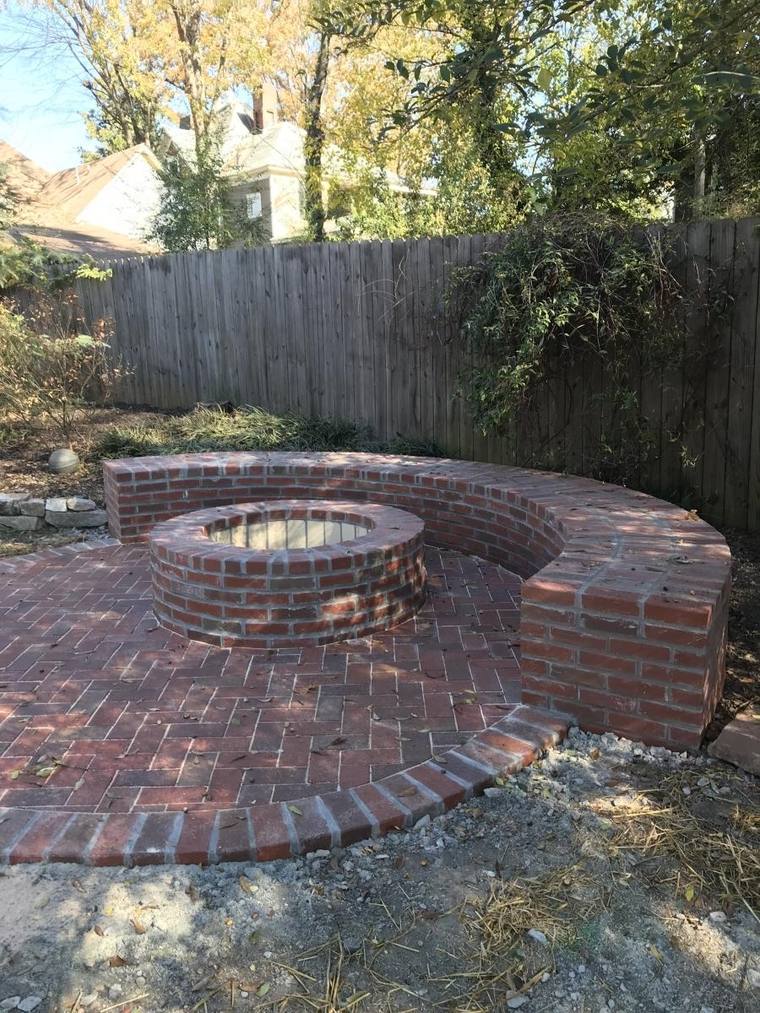
A straight bench faces one direction. A curved bench wraps the fire, which means the people on it are facing each other instead of all facing the same fence. That is the difference between a seating area and a row of chairs.
The back wall
This is the one that gets left off, and it is the one everybody notices. A bench with no back is a ledge you perch on for twenty minutes. Build a back wall into it and people stay for hours. It also does double duty: it blocks wind coming across the yard, it screens the fence line behind it, and it gives the whole area a defined edge instead of trailing off into the grass.
We build the bench and the back wall as one masonry structure, on the same prepared base as the surface underneath, so it does not settle away from the patio.
Brick, tile or stone
The fire pit, the bench and the back wall can be finished in any of the three, and in practice they should all match.
Brick
The most common choice here, because we can match the brick already on your house and the whole thing reads like it came with the place. Real brick, laid course by course, not a veneer panel. Holds up to heat and to a pressure washer.
Stone
Natural or manufactured stone when you want the fire area to read as its own feature rather than an extension of the house. Pairs well with a heavier, more rustic bench and a thicker cap.
Tile
Large format porcelain or stacked tile for a cleaner, more modern face, and it lets you carry the same material from the fire pit onto the patio floor. Easiest of the three to wipe down.
Whatever the face is, the cap matters as much. That is the surface people actually sit on and set drinks on, so it wants to be smooth, wide enough to be comfortable, and set to shed water rather than hold it.
What is underneath it
A masonry fire pit and a full bench are heavy, and heavy things on Louisiana clay need a base that was prepared for them. The surface they sit on — concrete or pavers — gets the same treatment as any slab we pour: organic material stripped, cut to grade, compacted base, and reinforcement inside the pour. We cover why that matters in our guide to concrete patios and what Louisiana clay does to a slab.
Get this wrong and the bench settles away from the patio, the joint opens, and water starts working into it. Get it right and it never moves.
Siting it properly
- Away from the house and the fence — far enough for safety and far enough that smoke is not blowing onto a covered patio.
- Downwind of where people sit most — our prevailing wind will decide who gets smoked out.
- Off the low spot — a fire area that holds water after a storm is a fire area nobody uses in spring.
- Check your HOA — some subdivisions in Prairieville, Dutchtown and Central have rules about open flame features. We handle the submittal.
- Leave room to walk — a clear path behind the bench so people are not stepping over the back wall to get in.
What it costs
A fire feature with a seating area falls under our $10,000 structures minimum, and the number moves with the size of the pit, the length of the bench, whether there is a back wall, the material, and the surface it all sits on. Our Supreme Outdoor Living package includes a brick wood burning fireplace or fire pit with a seating area, and The Don includes a gas fireplace or fire pit. Both are listed line by line on the pricing page.
Frequently asked questions
Can you build a bench around a fire pit?
Yes, and we recommend it. We build curved masonry benches sized to the fire pit, with a back wall if you want one, as a single structure on the same prepared base as the patio surface.
Should a fire pit be wood burning or gas?
Wood throws more heat, costs less to build and is what people sit around. Gas is cleaner, instant, and the only sensible option if the feature is going under a roof. Wood needs clearance from the house and the fence for smoke.
What materials can the fire pit and bench be built from?
Brick, tile or stone. Brick is the most common choice in this market because it can be matched to the house. The cap on the bench matters as much as the face, since that is what people sit on.
Do I need a permit for a fire pit in Ascension Parish?
An open masonry fire pit often does not require one, but gas lines do, and HOA architectural rules frequently cover open flame features. Requirements differ between parishes and subdivisions, so confirm with your parish office or let us handle the submittals.