Concrete is the cheapest part of a backyard and the part most likely to ruin it. A patio cover can be repainted and an outdoor kitchen can be re-veneered, but a slab that heaves, cracks through the middle and holds water after every storm has to come out. In South Louisiana, whether that happens has almost nothing to do with the concrete and almost everything to do with what was under it and how the water was handled.
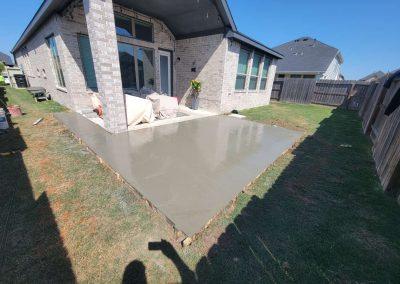
Start with the dirt, because the dirt is the problem
Most of East Baton Rouge and Ascension Parish sits on heavy clay. Clay is expansive: it takes on water and swells, it dries out and shrinks, and it does that seasonally, every year, under everything you build. In a wet spring the ground under one corner of your patio can be doing something different from the ground under the other corner.
That is why two slabs poured the same week by the same crew can age completely differently. One went over properly prepared, compacted base. The other went straight onto whatever was there after the sod was scraped off.
Proper prep means stripping the organic material, cutting to grade, and compacting a base so the slab bears evenly. Skipping it saves a contractor half a day and costs you the patio.
Thickness: four inches is the floor, not the answer
Four inches is the standard for a residential patio and it is adequate for foot traffic, furniture and a grill. It is not adequate for everything.
Go thicker when the slab will carry real weight: a driveway extension, a parking pad, a spot where a truck or a trailer will sit. Go thicker when a heavy masonry outdoor kitchen or a brick fireplace will sit on it, because a point load on a thin slab is how you get a crack radiating out from one corner of an island.
If a quote does not say how thick the pour is, that is not an oversight, that is the contractor keeping their options open.
Reinforcement is not optional here — and here is our exact spec
Concrete is strong in compression and weak in tension. When expansive clay lifts one part of a slab, the top of the slab goes into tension and it cracks. Reinforcement does not stop the clay from moving, it holds the slab together when it does — so instead of a wandering crack with a lip you can trip on, you get a hairline the slab holds closed.
We do not price reinforcement as an upgrade and we do not have a cheap version. Every pad and every extension we pour is reinforced. The only thing that changes is how much.
Every pad and extension: wire mesh and fiber
Standard on all of it. Wire mesh goes in and gets supported so it ends up inside the slab, not lying on the dirt underneath where it does nothing at all. Fiber goes into the mix at the plant and works at a much smaller scale, holding the concrete together as it cures and shrinks in those first days when most surface cracking starts.
They do different jobs. Fiber fights the fine shrinkage cracking while the slab is young. Mesh is what holds the slab together later, when the clay under one corner swells and the concrete has to bridge it.
Load-bearing pours: wire mesh, fiber and rebar
When a pad will carry the posts of a patio cover, or when a driveway or driveway extension will have a vehicle parked on it, we add rebar on top of the mesh and fiber. Point loads and vehicle loads are a different problem from furniture and foot traffic, and they need steel with real tensile strength in the right places — not a mesh sheet on its own.
This is the detail most homeowners never think to ask about, and it is the one that shows up two years later as a crack radiating out from the base of a post.
Yes, some of it is overkill. On purpose.
Here is the honest version. On a pour that will never see a vehicle and will never have a structure post set on it — a simple patio pad, a walkway, a small extension — running both wire mesh and fiber is more than the job strictly requires. Plenty of contractors would use one or the other and be within normal practice.
We do both anyway. The cost difference on our end is small. The difference to you is the gap between a hairline you never notice and a wandering crack with a lip you catch a chair leg on. We would rather know it is one hundred percent done right, with the lowest chance of a large crack, than save a few dollars on a slab that has to last as long as the house.
That is not a sales line. It is a preference about what kind of phone calls we want to be getting in year three.
Why the contractor matters more than the concrete
Concrete is the one part of a backyard you cannot inspect after the fact. Once the truck leaves and the surface is floated, every decision that determines whether that slab is still flat in ten years is buried under four inches of gray. You are not buying concrete — concrete is a commodity and everybody in this parish buys it from the same few plants. You are buying the judgment of whoever prepared the ground and specified what went inside it.
You do not need to know concrete to sort a good bid from a bad one. Ask these four questions and listen to how fast the answers come:
- How thick is the pour, and what reinforcement is going in it?
- How will the mesh be held up off the ground?
- Where will the control joints go, and when will they be cut?
- Where does the water go once this is poured?
A contractor who has to think hard about the second and fourth questions is telling you something useful.
Control joints: the cracks you choose
Every concrete slab cracks. That is not a defect, that is concrete doing what concrete does as it cures and shrinks. The only question is whether the cracks happen where somebody planned them or wherever the slab feels like it.
Control joints are the planned answer — cut or tooled lines that give the slab a weak point to crack along, below the surface where you will not see it. They need to be spaced sensibly for the thickness of the pour and cut early, while the concrete is still young. A patio with no joints, or with joints cut three days late, is a patio that will crack on its own terms.
A related detail: where a new slab meets the house or an existing slab, it should be isolated rather than bonded, so the two can move independently. Tying a new patio rigidly to a foundation transfers every bit of clay movement straight into whichever one is weaker.
Drainage, or where does all this water go now?
This is the part homeowners skip and regret. You are about to make several hundred square feet of your yard stop absorbing water. That water has to go somewhere, and if you put a roof over the patio you have added a second volume of water that now comes off in a concentrated sheet along one edge.
A patio should be poured with a slight, deliberate slope away from the house. Not enough to notice underfoot, enough to move water. Where the ground beyond it is already soft — and a lot of yards in Prairieville, Geismar and Dutchtown are — the slope alone is not enough and you need a drain, a French drain, or grading work to carry it to somewhere it can leave.
If your contractor did not ask where your water goes before quoting, they are not planning to solve it.
Concrete or pavers?
Both work here. They fail differently, which is the useful way to think about it.
Poured concrete is one monolithic surface: fewer places for weeds, less maintenance, and a cleaner look for modern homes. When it does move, it cracks, and repairs are visible.
Pavers are many small units over a compacted base and sand. Because they are independent, ground movement shows up as unevenness rather than cracking, and individual pavers can be lifted and reset. The trade is joints to maintain and a base that has to be done right or the whole field ripples.
Neither is the automatic answer. What matters far more than which you choose is the preparation underneath, which is the same work either way.
Finishes worth knowing about
A broom finish is the default: textured, grippy when wet, inexpensive, honest. Anywhere barefoot traffic happens, texture is a safety feature, not a style choice.
Stamped and stained concrete buy you the look of stone or brick at less than the cost of laying it, and they do hold up if they are sealed and resealed. Understand going in that sealer is maintenance, not a one time purchase, and that a slick sealed surface in a rainy climate needs a grip additive.
What it costs
Concrete only projects with Parish Outdoor Builders start at $2,500. Price moves with square footage, thickness, reinforcement, finish, how far the truck can get from the pour, and whether the job includes grading or drainage work. Our full price list is on the pricing page.
If you are weighing concrete against a covered structure or an outdoor kitchen on top of it, it is cheaper to pour once for the finished plan than to pour now and cut later. Have the conversation before the first truck, not after.
Frequently asked questions
How thick should a concrete patio be in Louisiana?
Four inches is the residential standard for foot traffic and furniture. Go thicker for vehicle loads and for slabs that will carry a masonry outdoor kitchen or fireplace. Thickness should be stated in your quote.
Why did my new concrete patio crack?
Usually one of four reasons: base that was not prepared or compacted, no reinforcement or reinforcement that sat on the ground instead of inside the slab, control joints missing or cut too late, or water that was never given anywhere to go. Hairline cracks along a control joint are normal and expected. A wandering crack with a height difference across it is a structural problem, not a cosmetic one.
Do I need a permit to pour a patio?
A flat, uncovered slab often does not, while anything roofed generally does, and rules differ between East Baton Rouge and Ascension Parish. Drainage work and anything that changes how water leaves your lot can have its own requirements. Check with your parish, or let your builder handle it.
Do you use rebar or wire mesh?
Both, depending on the load. Every pad and extension we pour gets wire mesh and fiber as standard. Pads that will carry patio cover posts, and driveways or driveway extensions that will see vehicle parking, get wire mesh, fiber and rebar.
What does fiber do in concrete?
Fiber is mixed in at the plant and works throughout the slab at a small scale, controlling the fine shrinkage cracking that happens as concrete cures. It complements mesh and rebar rather than replacing them.
Can you pour over an existing patio?
Sometimes, but it is usually the wrong move. An overlay inherits every problem of the slab underneath, including its cracks and its drainage. If the existing slab is sound and level, an overlay or a resurfacing can work. If it is moving, it comes out.
What areas do you pour in?
Baton Rouge, Zachary, Baker, Central, St. George and Greenwell Springs in East Baton Rouge Parish, and Prairieville, Gonzales, Geismar, Dutchtown, St. Amant, Galvez, Sorrento, Darrow and Donaldsonville in Ascension Parish.