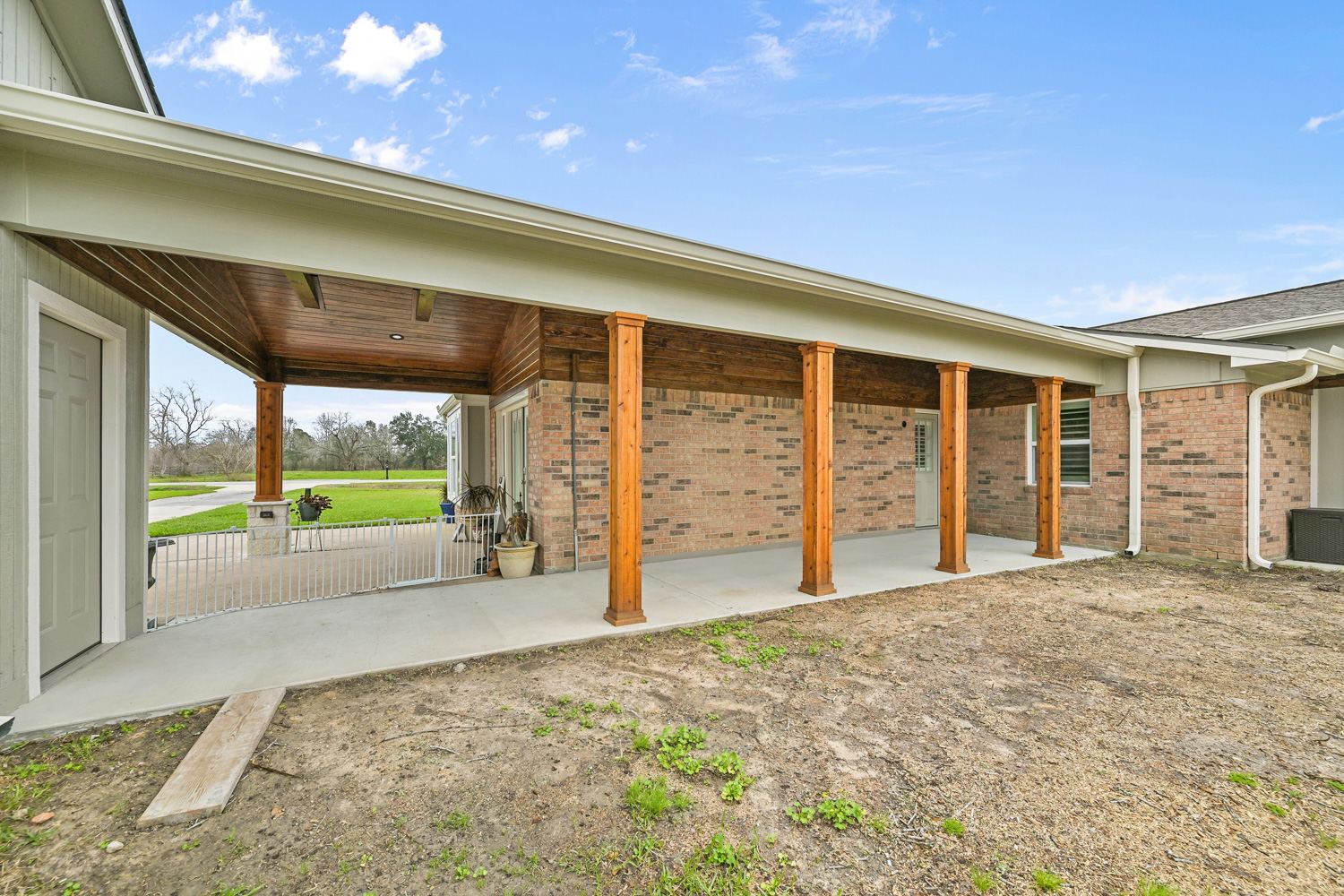
A pavilion or patio cover looks like a roof, a ceiling and some handsome posts. What actually holds it up is the part you never see: a concrete footing under every post. Get the footings right and the structure stays plumb and square for as long as you own the house. Skip them, and the first thing you notice is a gap opening at the top of a post, a gutter that no longer drains, or a crack running out from the base of a column across your patio.
What a footing actually is
A footing is a block of concrete poured into the ground underneath each post location, deeper and wider than the patio slab around it. Its job is to take everything the post is carrying — the roof, the ceiling, the fans, the lights, a wet storm’s worth of water sitting in the gutters — and spread it over enough soil that the ground can hold it without sinking.
The slab is the floor. The footing is the foundation. They do different jobs, and a good build treats them that way.
Why a patio slab is not a footing
A residential patio slab is about four inches thick. It is built to carry people, furniture and a grill, spread out across the whole surface. A post is the opposite kind of load: a lot of weight concentrated on a few square inches.
Set a loaded post on a plain four inch slab, especially near the edge, and you are asking a thin sheet of concrete to act like a foundation. Sooner or later it does what thin concrete does under a point load. It cracks around the post, the corner breaks off, and the post starts to settle. When one post drops and the others do not, the beam above it racks, the roof line sags, and the whole structure starts working itself loose.
That is why one of the first things we look at when someone wants a cover over an existing patio is whether the slab can take posts where they need to go. Usually the answer is to cut the slab at each post location and pour a proper footing underneath.
What Louisiana soil does to a structure
Most of the ground across East Baton Rouge, Ascension and Livingston is clay. It swells when it takes on water and shrinks when it dries out, season after season. That movement is gentle on a lawn and hard on anything rigid sitting on top of it.
A footing that goes down into the ground and bears on firm, prepared soil moves far less than a post sitting on the surface. It also gives every post the same kind of support, which matters more than people think. A structure can tolerate a little movement if everything moves together. What wrecks it is one post moving differently from the rest.
Wind pulls up, too
Everybody thinks about a roof pushing down. In South Louisiana, the bigger problem is often a roof being pulled up. Wind running under an open-sided pavilion or patio cover lifts it like a wing. The only thing resisting that lift is the weight of the footings and how well each post is tied to them.
A post sitting on a slab with a couple of anchors in four inches of concrete does not have much to hold onto. A post tied into a real footing has the mass of that concrete and the soil around it working for it. When a tropical storm comes through, that is the difference between a structure you inspect the next morning and one you find in the neighbor’s yard.
How we set footings on every pavilion and patio cover
- Every post gets its own concrete footing. No post on any pavilion or patio cover we build just sits on the patio slab.
- Sized for the structure and the ground. Footing size and depth follow the design for that structure, its roof and the wind it has to handle. A small pergola and a large hip roof pavilion do not get the same footing.
- Laid out before the slab. On a new patio, post locations are set from the plans before anything is poured, so the footings land exactly where the posts go and the slab is formed around them.
- Posts tied to the footings. Each post is connected to its footing, not just resting on it, so the structure is held down as well as held up.
- Included in the price. Footings are part of every structure we build and part of the number in your proposal, not an upgrade or a change order.
Planning a cover later? Tell us now.
Plenty of homeowners pour a patio this year and add a pavilion or patio cover next year. That works well, as long as we know about it before the concrete goes down. Tell us where the structure will go and we can plan the post locations and footings into the pour, instead of saw cutting a finished patio later to get them in.
Questions to ask any builder
You do not have to be a contractor to sort a good bid from a risky one. Ask these, and listen to how quickly the answers come:
- Does every post get its own concrete footing, or do some posts sit on the slab?
- How big and how deep are the footings, and who decided that?
- How is each post attached to its footing?
- Are the footings included in the price, or are they an extra?
If a quote for a pavilion or patio cover does not mention footings at all, ask. It is the most important thing on the job that you will never see again once it is built.
What it costs
Covered structures with Parish Outdoor Builders start at $10,000, and footings are part of every one of them. Our full price list is on the pricing page, and our guide to concrete patios in Baton Rouge covers what goes into the slab around the posts.
Frequently asked questions
Do pavilion and patio cover posts need concrete footings?
Yes. Every post on a pavilion or patio cover should sit on its own concrete footing that is deeper and wider than the patio slab. A four inch slab is built for foot traffic and furniture, not the concentrated weight and wind uplift a roof puts on a post.
Can a patio cover be set on my existing concrete patio?
Sometimes the slab can be used, but the posts still need footings. Usually that means cutting the existing slab at each post location and pouring a footing underneath. We look at the slab at the walkthrough and tell you straight what it will take.
Why do posts need footings in Louisiana?
Our clay soil swells and shrinks with the weather, and our storms put real uplift on roofs. Footings spread the load onto firm soil, keep every post moving the same way, and anchor the structure against wind pulling it up.
Are footings included in your price?
Yes. Every pavilion and patio cover we build has a concrete footing under every post, and it is included in the price on your proposal.